Ribfest and Regions Archery Tournament

archery hunting, arrows, big game hunting, bow and arrows, Camera, DIY hunting, Field Producer, hunting, Hunting Culture, Hunting with Camera, moose, Pennsylvania hunting, public land, Survival, The next generation, traditional archery, Ultimate Survival Alaska, Whitetail hunting, wildlife

Here is a few pictures from my adventures over the weekend competing in the Regions Archery tour in Warren Pennsylvania. I had a complete and total blast shooting arrows all day and throwing back BBQ ribs all night. I want to thank everyone in Warren county for their hospitality and generosity and for showing me a great time. I also want to give a few special shout outs to the staff and organizations running the archery tour, they all showed extreme professionalism setting up the best “world class archery tournament” I have personally seen. I also want to thank John Papalia and his family for hosting me, sponsoring me, and showing me an immense amount of kindness.

-Austin

20130723-163229.jpg

20130723-163135.jpg

20130723-163217.jpg

20130723-163202.jpg

20130723-163253.jpg

Hunting Season and Tags: Hunter Education

alaska, alaska hunting expedition, antler hunting, archery hunting, big game hunting, Hunting Culture, public land, Survival

Hunting season isn’t to far away and if you are thinking about stepping into the woods make sure to purchase your hunting license and accompanying tags.   Many states require hunters to fill out hunting reports online, these reports help biologists and Department of Wildlife officials maintain healthy population numbers, set game bag limits, and promote conservation through hunting.   With the internet this day and age, its never been easier to report your hunting adventures online at your states home webpage.

For instance:

In order to not be penalized for future hunting tags and permits, residents of the state of Alaska must report their prior years harvests before a set date.  

https://secure.wildlife.alaska.gov/index.cfm?adfg=interperm.report_greeting

Harvest Tag

Remember to always have the correct tag for the game species with your accompanying hunting license, simple Hunter Safety Education 101.  Hunting licenses and game tags directly benefit wildlife conservation and do many things for our cultural heritage and the tradition of hunting.  Don’t forget to fill out your hunting reports online, happy safe hunting everyone.


A Lower 48er’s View of Alaska

alaska, alaska hunting expedition, artic slope, bears, big game hunting, camping, DIY hunting, extreme hunting, guns, hunting, Hunting Culture, Hunting with Camera, National Geographic, nature, public land, Rifles, Survival, The next generation, Ultimate Survival Alaska, unguided hunting, Videographer, wildlife

After graduating with Austin from Penn State, It was our mission to gain experience in the outdoors, test ourselves as young men, and do the trip of our dreams. We wanted to do a low budget, non-guided hunt, using different means of transportation; through-out the state of Alaska for the “Alaskan Big 5”, Caribou, Dall Sheep, Mountain Goat, Moose, and Bear. The Mission Alaska Expedition was an amazing adventure, and one that Austin, Jordan Auggie, Sarah, Natalie, Bryan, and I will never forget.

As the lower “48’er” of the crew if was definitely a trip where I was out of my element. As I watch National Geographic’s ‘Ultimate Survival Alaska’, it brings me back to that expedition. The TV cameras make it look a lot easier than it is. They cannot adequately describe the tussocks, wetness, trench-rot, or blisters that come with successfully filming back-country travel. I wanted to share some thoughts on traveling the remote terrain as a real outsider, a non-Alaskan.

It was definitely like nothing I had encountered in the lower 48. It looks a lot like Kansas or North Dakota, but the wetness and endless tundra of the Alaskan arctic, make it like walking on a 3-5 foot wet sponge layer. Tussocks are hard plant root clumps that make the ground very unstable and a nightmare on your knees and ankles.

IMG_0111

Endless amounts of “tussocks”.

I will never forget how foreign the environment felt. After leaving our pick-up truck, we might might as well been walking on another planet. We only had to go 5 miles, but it felt like 20!

IMG_0119

A hard earned 5 miles out to the hunting area.

As I have been watching ‘Ultimate Survivor Alaska’ on National Geographic, I have been captivated by the scenery of the show and the crew’s ability to capture those images in the remote wilds of Alaska. I have filmed in Alaska and can assure you that the Alaska terrain is the enemy of any electronic device. The wet and the cold can make it very difficult to keep the cameras rolling, SD cards filled, and batteries charged. My hat is off to the Nat Geo production crew for capturing the raw and wild beauty of Alaska.

Cameras dont like working in clouds.

While Alaska can afford some beautiful weather with amazing views, definitely be prepared for cold and wet weather anytime of the year. Do not cheap yourself on gear! While you can sometimes get away with it in the lower 48, bad gear will ruin your trip and can endanger your life in Alaska. Make sure to check the Gear and Apparel page to see Mission Alaska’s gear tips, reviews, and suggestions.

DSC00071

A foggy August Alaskan view.

DSC00073

Looking for sheep in ever-changing weather.

There are all sorts of terrain in Alaska and a trip suited for everyone. Not far outside of the metro areas of Anchorage or the Mat-su Valley are tons of foot accessible areas. You dont always need planes and helicopters in Alaska to experience a real adventure. A lot people come to Alaska and take to bush planes to get out to remote areas. This can leave those areas crowded and areas that are hard to hike to, but not as far out as the planes go, open to anyone who wants to work for it. I had a mission to further test myself and went on a solo black bear hunt. What a great challenge and feeling of accomplishment.

IMG_0182

Solo black bear harvest

The Mission Alaska Expedition was for sure the hardest thing I have ever done and the trip taught me a lot about myself, life, and Alaska. I encourage more Americans in the lower 48 to go and experience the last american frontier. It is still very real and alive today. Read ‘John and Joe’s Philly to AK Adventure’. Just like Nat Geo’s ‘Ultimate Survivor Alaska’ shows, for those who want it, adventure lies waiting around every corner.

IMG_0141

Whats Your Mission?

-Jon Dykes

Brookes Range – Gates of the Arctic – “The Arrigetch”

alaska, alaska hunting expedition, antler hunting, archery hunting, artic slope, bears, big game hunting, bow and arrows, Camera, camping, DIY hunting, extreme hunting, grizzly bear, guns, hunting, Hunting Culture, National Geographic, Ultimate Survival Alaska, Uncategorized

Brookes Mountain Range – Gates of the Arctic – “The Arrigetch” – Bob Marshall

Need I say more? The names mentioned above are legendary, well-respected, and admired in the Alpinist world of exploration. The Gates of the Arctic are truly wild; nestled among some of the gnarliest mountains Alaska has to offer. To begin above the Arctic Circle and end in South West Alaska with nothing but the gear on your back is a daunting task. The challenge set forth by Nat Geo was to embark on this expedition in an “old-school” style, i.e. no fancy technology. This expedition was a throwback to the early days of Alaskan exploration; a journey that traces the pages of history and an ode to the past explorers who came to Alaska and explored the last frontier with minimal gear and technology.

Bob Marshall was an Alaskan explorer who came to the state after exploring a large portion of lower North America. Bob said it best, “I like it among these rugged mountains better than anywhere else in the world.” I relate to the past explorers who came to this state in search of the majestic beasts that roam this fabled land. Traditional archery hunters such as Doctor Arthur Young and Fred Bear will forever be my heroes. Their accomplishments inspired me to follow their footsteps and live and adventurous lifestyle. For the first leg of the expedition the “Elite 8,” which consisted of survivalists, outdoorsmen, climbers, skiers, dog mushers, and mountaineers, began the journey in the Brookes Range. The Nat Geo expedition was the third time I have made my way into the Brookes Range. All three experiences within this epic mountain range were very different, but equally unforgettable.

My first trip to the Brookes Range was several years ago. My brother August and I flew out to hunt dall sheep. The time spent in the north-eastern part of the Brookes was so incredible and also humbling. I cherish the moments my brother and I spent together in field chasing white ghosts with golden horns. We had a close call with a gnarly feature on one particular mountain top. The terrain taught us valuable lessons in survival…always bring rope with you…at some point you will need it. We ended up rappelling off 50-100 foot cliff faces until we ran out of rope. We were faced with a real moment of survival, we had to adapt or die. We ended up climbing down the last 1000 feet in reverse 4-wheel drive with automatic death to the right and instant death to the left. You can read all the survival guides in the world but unless you go outside and experience them first hand, it’s all for nothing.

DSC02516 DSC02538 DSC02586 DSC02582

The wilderness puts an individual’s ability to cope with their surroundings to the test. It was during hunting adventures like these that my brother and I learned to understand each other’s strengths and weaknesses. Our goal always being to turn our weaknesses into strengths. Together we learned new ways to solve simple problems. These experiences inspired my survival mantra; “team work makes the dream work.” I was much more prepared for my second and third trip to the Brookes Range.

On my second trip to the Brookes Range, my brother, John Dykes (college rugby buddy), and I set out on a quest called the “Mission Expedition”. This expedition took us from the Acrtic sea above the Brookes Range all the way to the Kenai Peninsula, and several locations in the interior. The mission of this expedition was an attempt to fill the freezer with beautiful, free ranging, no hormonal, wild game meat. Being an Alaskan resident we have the unique opportunity to hunt for the big five game animals that call Alaska home. Hunting these animals every year is a part of our Alaskan culture, not to mention the incredible taste and gratification recieved by filling your freezer on your own terms. This second trip would prove invaluable as I learned the terrain, topography, and easiest methods of travel in the Brookes Range the key being the waterways.

My past experiences in the Brookes Range taught me many valuable lessons to take with on the Ultimate Survival Alaska Expedition with National Geographic. I learned mainly that waterways are your friend, and to follow this path of least resistance. Using rafts to minimize the distance of our caribou pack out on a previous expedition, I understood the advantage of bringing along a pack raft. Bringing along a raft would at least provide us the ability to forge and cross rivers, if not to float the entire river to the landing zone. Being as this was a team mission, having a solo packraft would only let me float to the LZ and leave my partners behind. Understanding their need for river crossings help, I stuck with the mantra of “team work being dreamwork” and stayed with the group to help them forge rivers. That being said, I look forward to future adventures with my team members and would do this leg of the expedition all over again.

Check out the gear list below, with these essential items and a basic knowledge of how to use them an individual would be ready to survive just about anything.

Survival Guide Gear List:

-Magnesium Fire Starter

-Knife -full tang

– Fishing kit: Line with various hooks and spinners.

-Tarp 8×10

-Pack Raft

-Back pack or external pack frame

-Water Bottle or container

-Longbow, rifle, pistol, self defense weapon

-Sleeping bag -0 rating

-Bivy Sack

-Plenty of socks

-Food (coffee, oatmeal, rice, beans, whiskey, ramen noodles) what ever you can carry. If you can pack as much calorie dense food as possible.

Facts Courtesy of Wikipedia: Gates of the Arctic National Park and Preserve

Gates of the Arctic National Park and Preserve is a U.S. National Park in Alaska. It is the northernmost national park in the U.S. (the entirety of the park lies north of the Arctic Circle) and the second largest at 13,238 miles (34,287 km²), about the same size as Switzerland. The park consists primarily of portions of the Brooks Range of mountains. It was first protected as a U.S. National Monument on December 1, 1978, before becoming a national park and preserve two years later in 1980 upon passage of the Alaska National Interest Lands Conservation Act. A large part of the park is protected in the Gates of the Arctic Wilderness which covers 7,167,192 acres (2,900,460 ha).[3] The wilderness area adjoins the Noatak Wilderness Area and together they form the largest contiguous wilderness in the United States.

History Courtesy of Wikipedia:

Nomadic peoples have inhabited the Brooks Range for as many as 12,500 years, living mainly on caribou and other wildlife. The Mesa site at Iteriak Creek has yielded evidence of occupation between 11,500 and 10,300 years before the present. Later sites from around 6,000 years before present have yielded projectile points, stone knives and net sinkers. The Arctic small tool tradition (ASTt) of about 4,500 BP has also been documented.A late phase of the ASTt from between 2500 and 950 BP, the Ipuitak phase, has been documented in the park at the Bateman Site at Itkillik Lake.[10]

The earliest Inupiat people appeared about 1200 AD at the coast and spread to the Brooks Range, becoming the Nunamuit.[10] The Nunamiut people existed essentially unchanged until World War II brought outsiders into Alaska, which was at the time a strategic outpost of the United States. Some of the nomads began to settle in small communities in the mountains, particularly at Anaktuvuk Pass.[11] TheGwich’in people, a Northern Athabaskan group also lived in the area in the last 1000 years, moving south of the park in historic times.[10]

The Alaskan interior was not explored until the late 19th century, shortly before discovery of gold in the Klondike brought prospectors to Alaska. Some encampments of explorers and survey parties have been identified in the park. A few small mining operations were established in the early 20th century, never amounting to much.[10]

The park’s name dates to 1929, when wilderness activist Bob Marshall, exploring the North Fork of the Koyukuk River, encountered a pair of mountains (Frigid Crags and Boreal Mountain), one on each side of the river. He christened this portal the “Gates of the Arctic.” Marshall spent time in Wiseman during the early 1930s, publishing an account of the place in his 1933 book Arctic Village. In the 1940s writer and researcher Olaus Murie proposed that Alaskan lands be preserved.[12]

Proposals for a national park in the Brooks Range first emerged in the 1960s, and in 1968 a National Park Service survey team recommended the establishment of a 4,100,000-are (41,000 ha) park in the area.[11] That year, Secretary of the Interior Stewart Udall recommended to President Lyndon B. Johnson that Johnson use the Antiquities Act to proclaim a national monument in the Brooks Range and other Alaskan locations, but Johnson declined. By the 1970s the Alaska Native Claims Settlement Act (ANCSA) prompted serious examination of the disposition of lands held by the federal government. A series of bills were proposed to deal with the settlements required by ANCSA, but the Alaska National Interest Lands Conservation Act (ANILCA) was held up in Congress in the late 1970s. President Jimmy Carter used the Antiquities Act to proclaim the proposed parklands under ANILCA as national monuments, proclaiming Gates of the Arctic National Monument on December 1, 1978. In 1980 Congress passed ANILCA, establishing the monument lands as Gates of the Arctic National Park and Preserve on December 2, 1980.[12]

http://en.wikipedia.org/wiki/Gates_of_the_Arctic_National_Park_and_Preserve

Find the Gates of the Arctic on facebook @

https://www.facebook.com/GatesOfTheArcticNPS

20130518-124306.jpg

20130518-124349.jpg

20130518-124454.jpg

20130518-124552.jpg

20130518-170108.jpg

20130518-171055.jpg

20130518-171303.jpg

Hunting Whitetails: Part Three Success

big game hunting, DIY hunting, hunting, Hunting Culture, Pennsylvania hunting, Whitetail hunting

Due to work and the daily grind of life, I was unable to hunt Alaska frequently this fall. Knowing that the Thanksgivng holiday coincides with the opening Pennsylvania deer rifle season, I could potentially make up for lost time in the woods. This year Jordan Pokryfki decided she wanted to partake in the annual whitetail hunting festivities. After several days of hard work an preparation, this hunting season was about to pay off. Hanging tree stands, putting out trail cameras, sprinkling doe urine on our feet, you know the works…
I even resurrected the dead this year. I cut off and froze my last years buck’s tarsal glands, thawing them out and dragging them to Jordy’s and my tree stand. This drag mark made deer think that we were just another deer, possibly an old herd member.

The Hunt
We woke up at 430am, showered then began eating breakfast. Slamming three cups of coffee, Jordan, Auggie, and I were ready to attack the woods. Auggie headed to his tree stand, while Jordy and I headed for the double tree stand at the top of Allegheny ridge.
Jordan and I arrived at the double stand around o dark thirty(6:15am). We climbed into the stand and lashed our saftey harnesses to our anchor tree. We sipped on coffee till the sun rose, then began to wait. The waiting and the freezing was the hardest part, although we were determined. The one factor during opening season hunters can rely on is that close to a million hunters, maybe more, hunt Pennsylvania opening deer season. With hundreds, maybe thousands, of coordinated drives, hunters no-doubt move deer. Sitting and waiting a good travel corridor is often the most boring but most successful technique.
Jordy and I waited and saw eight doe run by at mock speed. Then it was silent for an hour or so, a small six point buck came strolling right past our stand at 40 yards. Three points a side is legal in the county we hunt, so I asked Jordy to put her cross hairs on the buck. She did and said, let’s let this guy get bigger for next year. Tapping cou on this small buck Jordan demonstrated traits of a seasoned veteran to the outdoors.
Letting the smaller bucks get bigger for the next hunter is always hard to do, however is a necessary part of being a true sportsmen. After the buck caught wind of us, he took off for the next county. We sat patiently another 4 hours before Jordy spotted two bucks running a top the ridge. I grunted using my primos buck roar and they turned on a dime running exactly for our double stand. Around 70 yards I yelled “burrrrrap” then whistled. After a brief moment of communication I told jordy to shoot either buck as I saw both were eight points or better and legal to harvest in our WMU. They both stopped when they heard my mouth grunt and looked beyond our stand. Jordy and I both shot, with the plan that she went for the first buck and I went for the second buck. Jordan’s shot connected with the first buck while my shot was deflected off an oak tree branch and missed. Her deer dropped. I reloaded my rifle immediately while the second buck pranced across the forest and almost out of shooting range. He stopped for a brief moment only showing his vitals through a tangle of beech nut trees, I touched of a shot and the deer walked off. Climbing down from the tree, Jordan and I walked to examine her buck. A beautiful eight point laying on snow covered forest floor. Being so excited and proud we both hugged.
I decided I had better check the deer tracks and the area of the second buck, as any ethical sportsmen would do. I found no blood, however I did find hair. Following the bucks tracks in the snow, Jordan and I noticed more hair and tiny blood droplets in the snow. Following this blood track another 70 yards, I stumbled upon my buck a beautiful broken tined 10 point. Exhilarated from our successes Jordy and I both hugged again and I cheer in pure excitement. What another wonderful time spent in the woods. Hard work and preparation payed off in a big way for Jordy and I, these sportsmen could not have been happier.

20121128-164835.jpg

20121128-164901.jpg

20121128-164923.jpg

20121128-165130.jpg

20121128-165522.jpg

20121128-165645.jpg

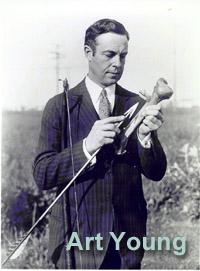
Legendary Archer: Arthur Young World Champion Archer Takes on Alaskan Expedition. Video

alaska, alaska hunting expedition, archery hunting, arrows, bears, big game hunting, bow and arrows, caribou, grizzly bear, hunting, Hunting with Camera, meat, moose, public land, traditional archery, trout, Trout fishing

This is possibly the coolest youtube video I have ever viewed.  This video shows world champion archer Arthur Young on an epic expedition across the state of Alaska subsisting with only a traditional longbow and arrow.  He takes on dall sheep, moose, brown bear, small game, salmon, and basically everything in between.  Arthur shoots a moose with his longbow, then uses its hide to build a canoe and float down the freezing Yukon River.  He spends times hunting with the Alaskan Natives on the his way to hunt brown bears in Kodiak.  This black and white video is awesome, watch legendary bowmen Art Young take on Alaska “old school” with only stick and string.

Image Courtesy of http://www.stickbow.com/stickbow/history/ArtYoung.html

Check these links out if your interested.

Exploring the Wild: Alone or in a Group?

artic slope, big game hunting, Camera, camping, DIY hunting, hunting, Hunting Culture, Hunting with Camera, meat, moose, Uncategorized

DISCLAIMER: I am writing this article on a foriegn keyboard so I apoligize for spelling errors and anywords that are autocorrected.

Whether it is a week long hunting trip, a three night camping trip, or a day hike the same questions seems to always arise: Who are you going with? If you are anything like me then thats the most despicable question you will ever encounter.

Image

Solo Bear hunting trip with my Recurve bow

It is my belief that to truly enjoy the outdoors and completely immerse yourself in the beauty and raw power of Mother Nature you have to cut ties with all forms of civilization and really go by yourself. Now some people would say that is a death wish and call me ignorant and stupid. I call it adventerous and exhilerating. With that being said going hunting or camping with someone can be just as fun, but you absolutely need to find that perfect fit. Going hunting with someone is not as easy as it may seem. You need to trust that person completely with your life because if you dont, their true colors will come out in a time of most need. Perhaps not on the first or second trip, but when it does happen it could very well be fatal. When looking for someone to explore the wild with you there should be several componets that they possess such as physically fit, mental strong, a good attitude and a good personality. These are just a few, but the most important one is their morales and ethics. These two things are above all the most important things that you should look for when you find that someone who you will be outdoors with.

Image

Gameface

You want to be confident that your partner will not take Mother Nature for granted and disrespect her or any of the animals that she allows to live in her kingdom.

With that I leave you to ponder, but stay updated with missionak and spread the word, posts will be coming weekly hopefully so stay updated!

Mission Alaska Third Leg: Bridgers Birth Into the World of Hunting

alaska, bears, big game hunting, Camera, camping, DIY hunting

Mission Alaska Part 3: Bridger’s Birth Into the World of Hunting

After fueling up at the boat dock and heading face first into Prince William Sound, within minutes we were off on yet another hunting adventure. Hunting several years previously in Valdez with Jason Semler, I knew it would be a matter of no time before we saw bears feeding on seaside mountain slopes.  Motoring out to one of Jason’s secret Valdez hunting locations called “Bearadise Bay” we came to a coasting slide in the boat.  Jason scuttled to the back of the boat, grabbed his monstrous fish gaff threw that hook over board and nabbed up a buoy.  Think Deadliest Catch, with out the crabs and on a smaller boat.  His 25 foot aluminum boat had a rope pulling rig on it that did quick work of the shrimp pots.  He hauled up three shrimp pots while discussing the hunting game plan with Bridger and I.   He said “we are going to motor towards these bays, and slowly scan the mountain side.”   Mean while, the pots he pulled up had enough banana size shrimp in it to make one “heckuva” meal, as Jason put it.  Taking his advice I pulled one shrimp out and cracked it open, pealed his shell then ate that little guy raw.

Banana sized shrimp

Banana sized shrimp

taste just as good like this

Taste just as good like this…

as they do like this. : Shrimp in salsa and butter

as they do like this: shrimp in salsa and butter

The salt water and the taste is similar to shrimp cocktail at a party, no cocktail sauce was needed.  Jason said hold off on eating them raw as he had an idea for these little buggers.  On a mini Coleman stove he crammed a boat load of shrimp with butter and salsa.   We proceeded to house those for a quick meal, before continuing to hunt the seaside mountain faces for our bear friends.  The shrimp was an excellent alternative to the standard protocol of Top Ramen noodles and water from a camel pack.  Jason fired up the boat and continued to motor on.  Bridger Vaness the Videographer of the trip was now in the driver seat and hunting big game for the very first time.  I would be lending a hand and going on the stalk with him as his second set of eyes.

“Bear, Bear, Bear” Jason points to a bear on the cliff side as I am taking a quick nap.  He startled me, but Bridger was so wide eyed and excited he was already standing.  After watching the bear for an hour or so and deciding this was a sole mature bear, we made the call to go after it.  Jason quickly motored over to the cliff side rocky shore and said “follow the tracks to the top of trail and shoot from one of the trees at the top of the rock face.”   Bridger nodded, and I agreed to come along for the stalk while Jason captained the boat.  Jason kicked the boat into reverse right before hitting the rocky edge of the boulder laden sea bank.  Bridger and I bailed out on the rocky bank and military crawled up the 6-8 foot snow base to the set of “human/bear tracks” we could see.

We got to the tracks and followed them near the top of the hill, they led directly to three small cottonwood trees.  Bridger and I had not located the bear yet, Bridger picked the tree he was comfortable shooting from and laid down.  He was shooting off of a shooting stick buried into the snow bank.   I located the bear, which was very close around 130-150 yards directly above us feeding on a cliff side.

He found the bear but was not steady to take the shot.  I told him to “lay prone off of the snow bank.” He dropped down off of the shooting stick using the snow bank to shoot from.

He said “Oh yeah, I got him!” to which I replied “ aim low center mass and roll him when it turns broad side.” As I ended that sentence “buuuhhhhdooooom!”  Ringing out and echoing off the cliffs, Bridger’s shot conducted a hunters orchestra with a “fuuwhaap” finale signaling the sound of a fatal hit.

The bear immediately tumbled off the skunk cabbage cliff, scrambling to catch itself before falling into an avalanche snow chute.   Falling 60 yards strait down, the bear expired on top of an alder covered avalanche chute.   With no movement from the bear, we grabbed our packs and headed to retrieve the animal.  A 30-minute hike nearly strait up, and Bridger found his very first big game animal.  We used the snow slide to drag the bear down near the boat to begin the next steps of the process.  The next step Bridger learned was validating his harvest card immediately before processing any of the animal.    We snapped several pictures together to commemorate the camaraderie shared on this hunting adventure.   After a short round of picture taking, we then processed and salvaged the entire bear.

Making quick work before the falling sunset on Valdez, we motored back to harbor before dark.  Who would have thought in three days we could harvest two beautiful black bears and make lifelong lasting memories.   Idling back to the boat launch in Valdez, we parted ways with Jason and thanked him for his friendship and camaraderie. Driving 8 hours back home to Palmer would go by fast.  Bridger and I both grinning ear to ear with success, the drive was filled with laughter and stories. The next steps would be processing both the bear’s meat into delectable packages of meat, and “officially sealing” the bear with Wildlife officials.   All was completed successfully and everyone who took part in the adventure could not have been happier.

Bridger’s first big game harvest with Austin Manelick and Jason Semler

I must say that helping another person with their first big game hunting experience is pretty magical.  I know that going on an adventure like this and harvesting an animal as Bridger did, will leave a lasting trait engrained in his gene code forever.  Sharing my passion with someone in my opinion is one sure fire method to keep hunting around for generations to come.  I receive just as much if not more pleasure, when someone else deserving harvests an animal that I know will be used in the capacity nature intended.  I was so happy for Bridger harvesting his first bear, it put as much of a smile on my face as it did on his.  What a cool memory shared together, the pictures will be enjoyed for years to come and the meat for many months.   Thanks to everyone who was involved in the bear hunting this year, it could not have been done with out you.

Austin and Bridger

Stay tuned for the  2012 Alaska fishing season!!

Gear List

-Photon 10X40 Russian made Binoculars

-Barneys Pinnacle Pack

-Hidden Antler Jersey

-350 Remington Mag.

-Mendhl Boots

-Mamut Champ Pants

-MSR Snow Shoes

Mission Alaska: Spring Bear 2012 Second Leg

alaska, alaska hunting expedition, bears, big game hunting, Uncategorized

-Journey to Valdez

As any hunter does, after missing a shot on their quarry, I felt a sense of desperation come over me and the instinctual crave for another shot opportunity.  This feeling would cloud my agenda over the next four days of this spring Alaska bear hunt.  After missing a large black bear while hunting with Vince Pokryfki, I felt the need to redeem myself.  The feeling of redemption would be the clarity needed to help me succeed on the next leg of my two week bear hunting journey .  Only stopping at the home base of operations in Palmer Alaska to do a confidence shot (sight in) with my 350 Remington Magnum.  An eight hour drive to Valdez, gave me plenty of time to meditate and concentrate on the days past events.

Fireside contemplation

Thinking deeply on developing a new game plan on how to harvest a black bear, I had one tactic in mind.  Talking with the locals proved to be the most crucial piece of advice for the entire hunt.  During the drive I called and contacted several locals and asked them if they had seen any bears in the Valdez area.  The most popular reply I received was “the bears are everywhere down here.”  The odds seemed to be in my favor and the phone conversations sparked my imagination; my thoughts became crawling with bears.

The drive to Valdez is full of breath taking views of mountains so big and vertical, they seemed to reach out and punch you in the face.  An interesting place to hunt black bears for sure, the area looked to hold more mountain goats than black bears.   Working off of previous knowledge and tips from the locals, I knew of two hunting locations near town that held big bears.  These two areas provided great hunting, at a very steep price.  The black bears littered the mountains, however getting up in a shooting position would not be a simple task.

Typical Alaskan view

After deciding via coin toss which of the two locations would be first, the hunt began from the parking lot.  After only five minutes of glassing, we had already spotted four bears – one sow with two cubs and one promising boar.  I proceeded to throw on my snow shoes and Barneys Pinnacle Pack frame and trekked a mile and a half to the base of the mountain.  I kept my eye on the bear as I hiked up the 6000 foot nearly vertical mountain.  Everything looked a lot different once I was on the steep mountain face hiking toward the last location of the boar.   Re-locating the animal as you get closer to them is a crucial technique in hunting big game animals in Alaska.  Finding the game is a small fraction of the battle, judging their size, closing the final distance for the shot, packing the animal out, and filling out your tag correctly are all parts of the journey.

As I proceeded to close the distance on the boar, I lost sight of him around 600 yards as he fed through an overgrown jungle of alder bushes.   With a good vantage point on a protruding mountain shelf, I hunkered down on an alder stand waiting for the animal to show himself.  I knew, if I gave him enough time, the bear would unknowingly walk right by me.  He was completely unaware of my existence on the mountainside as I laid like a frozen predator in silence.  Wearing “whites” (white jacket camouflage) to disguise myself on the snow shelf, the bear revealed himself around 300 hundreds yards.   The only way to explain my vantage point was like Mark Whalberg in the movie Shooter.  Yeah, the last scene in the movie up in the mountains (you know what I’m talking about), when Marky Mark Whalberg looks likes a chunk of snow.  The bear walked directly towards my position. I waited like a patient spider on my web of snow. I had just enough time to judge the size and the sex of the bear.

Glassing in “Whites”

From two miles away I predicted the bear to be a large boar black bear approximately 5-6 ft squared.  I noticed the bear was not behaving like a large boar at all, a large boar usually takes his time during travel.  This bear was moving quickly, and before long this large bear from far away, was actually a very small bear when up close.  Judging the size of bears is very difficult, knowing the behavior of the animals helps.  Small bears generally move much faster than larger bears, bigger bears take their time with no rush.  Also, ear size, leg length, belly drag, skull/nose size, are factors that play into judging a bears size.

Another great bear hunting vantage point

The bear walked within two hundreds yards of me before turning back up the mountain feeding back into the nasty tangles of alders.  The bear was about two years old and about 4.5-5ft squared in size.  This was not the type of bear I wanted to harvest, so he fed away from my position unknowingly that I had tapped cou on his head.  It was awesome to watch the bear in his own element unaffected by human presence.  Bears are the ultimate land predator and there is something to be said about viewing them in their natural element.  Finding the four resident bears in the first hunting spot in Valdez, I decided this area only contained a small boar and a female with cubs.  If a big boar lived in that area, I never found him and he lives on for the next outdoor enthusiast to enjoy.  I decided to come down from my high vantage point and change locations to my second area in Valdez.

Sleeping straight up and down in the seat of a truck was an excellent alternative to sleeping on the 8ft of snow base in the Valdez area.  Not to mention the frozen rain, now starting to pour as I neared the base of the mountain and the truck’s location.  I arrived at the truck and made a Top Ramen package accompanied by a camel pack of water. An excellent meal and some much needed hydration was necessary for a great night’s sleep.  I drove to my new location, which was just outside of Valdez, parked the truck and fell into a deep slumber. Waking up in the morning to more frozen rain, I knew it would be a great day of hunting.  Already in position to glass for bears, I was confident I would find an early morning monster bear.

Breafast consisted on four gulps of water, and a peanut butter Oreo tortilla snack (a family hunting snack).  After an hour or so of glassing with no bears in sight, we relocated.   The mountains in Valdez are a site to behold.  From sea level to 5000 feet, these mountains are nearly vertical.   Avalanche danger would also be a preventative matter and precautionary step taken into account on any stalk or game plan.  During the adventure, several “avies” avalanches made themselves known by a thunderous mega phone of power.   Knowing the “avies” could sweep me into the white abyss, venturing above tree line would be the last resort to harvesting a bear.  With a record snow fall in Alaska for the 2011-2012 winter, the snow was a critical factor in the spring 2012 hunt.  Sticking to the roads would be one of the only options for this hunt.

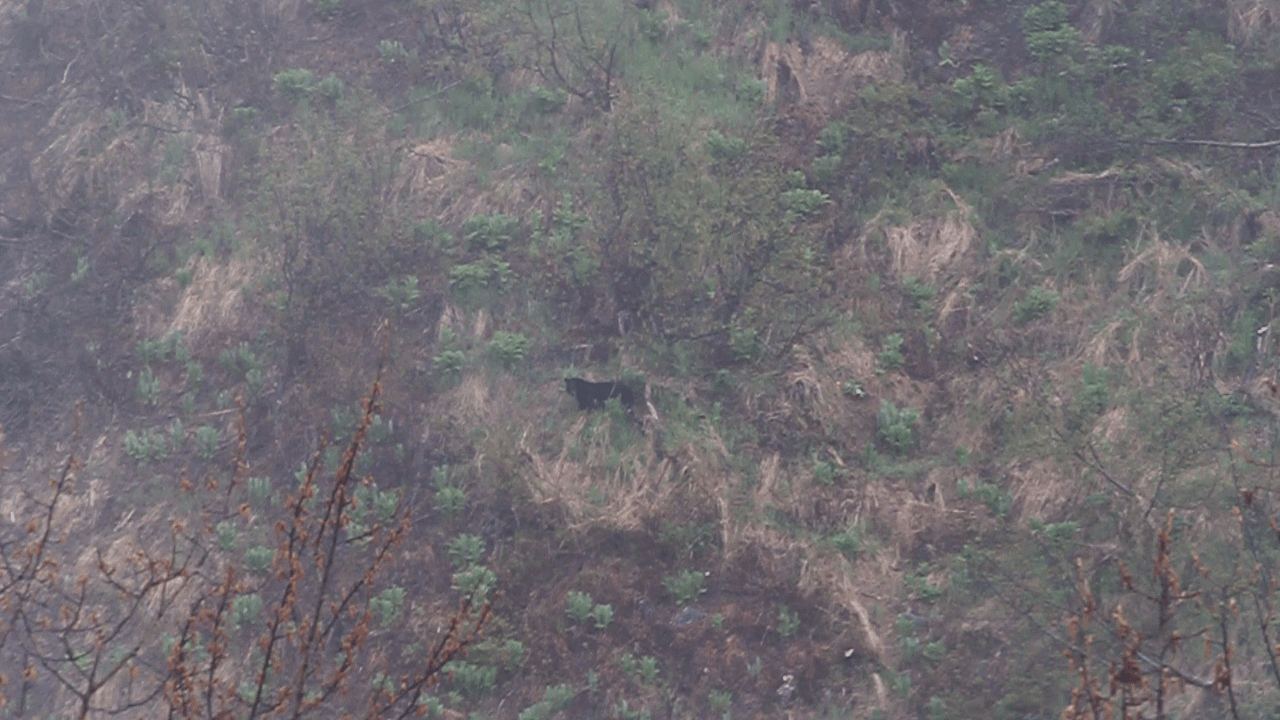
After a two mile drive, the dirt road changed abruptly. We were coming across potholes so big they could swallow an ATV.  Driving slowly to dodge the potholes allowed me to “bare eye” the mountainside.   “Is that a bush bear?” I said to Bridger the Videographer, thinking I was fooled by a dark colored piece of vegetation.   Stopping to verify what appeared to be a bear, the binos clarified that this was no bush bear.  In fact, this was the mature black bear that I was looking for.  Pulling the truck safely off the gravel pit roadway and finding a good parking spot was the immediate next order of business.  Coming to a halt and coordinating a filmed stalk with Bridger, the bear was 1000 yards and feeding on a hill side. A large cottonwood tree grove separated the bear and the fiddle head fern hill side between the gravel pit and truck.   The long stalk would take us far from the road side and deep into the cottonwood jungle, the bear was unaware of the impending inevitable.  Closing the distance using gigantic trees to shield my movements from the bear was the key to taking an ethical shot.

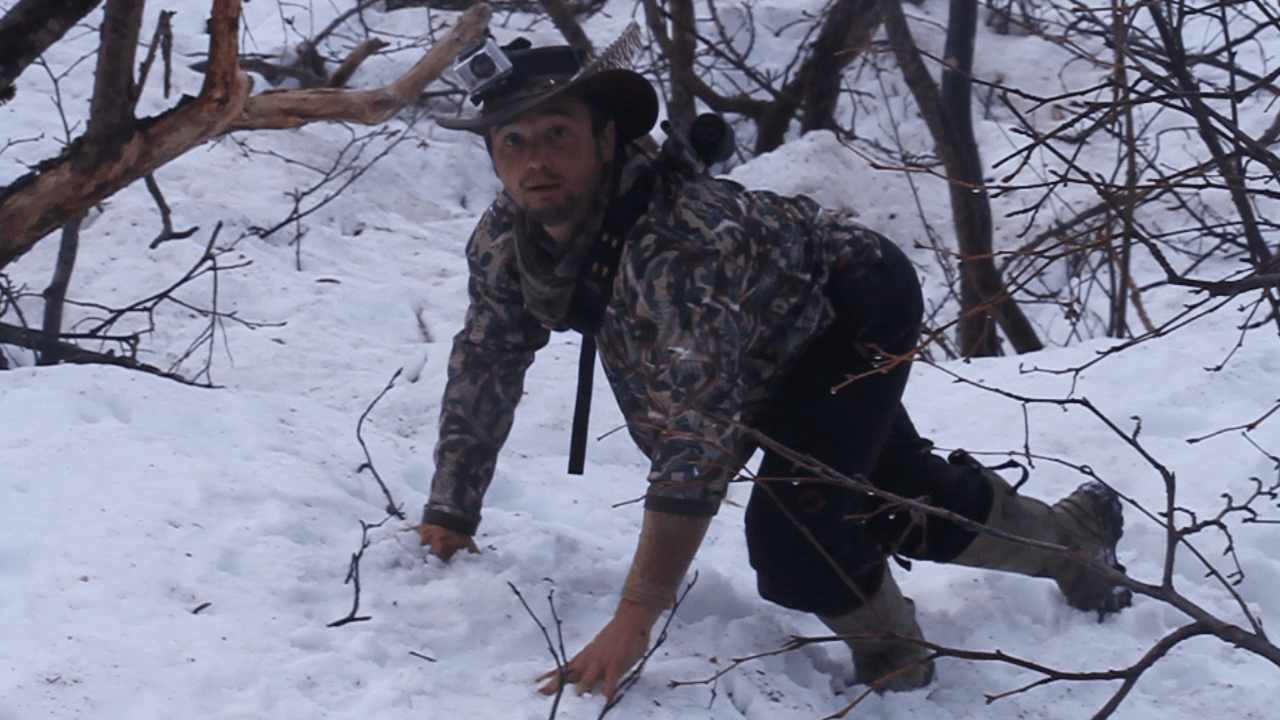
Bear crawling was the only option

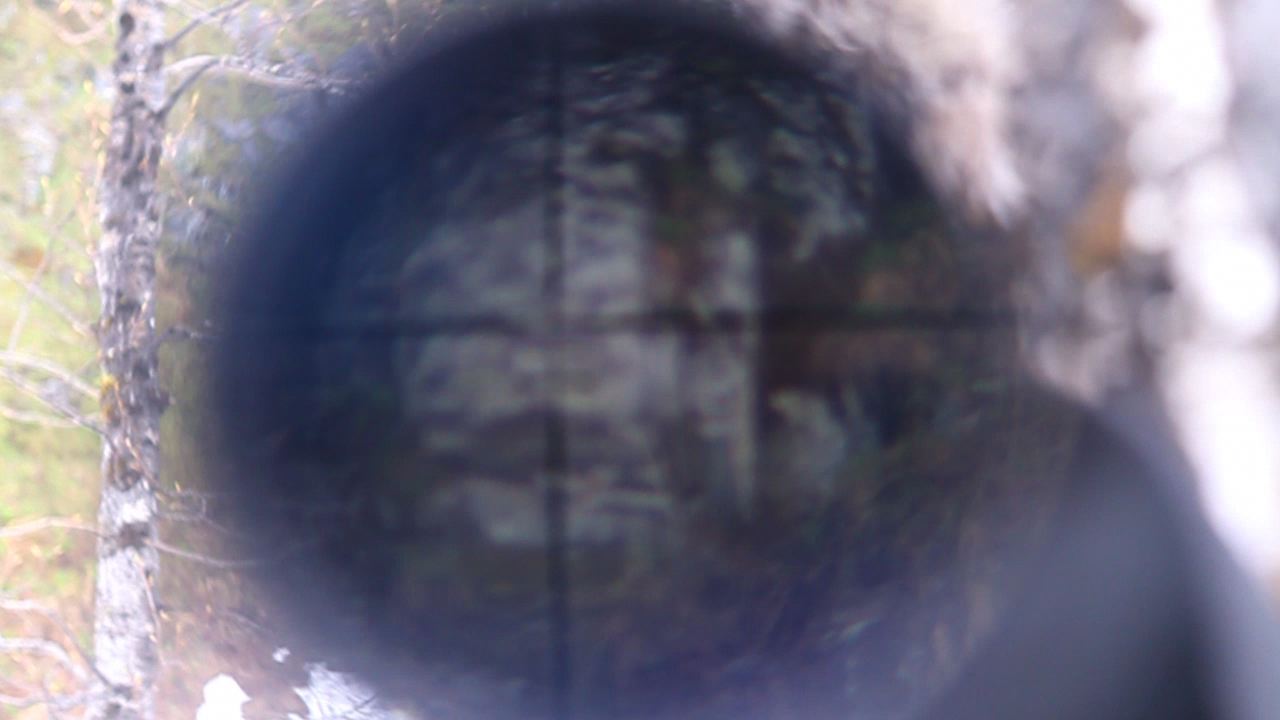
Two hundred yards away, the crunchy snow gave the bear a direction to look at.  The bear was now aware something was close, losing interest it went back to feeding.    “If only I can get within 170 yards, I could take a shot,” I thought to myself. The crunch of the snow under our feet was too loud. Bear crawling to spread my weight out would be my only option.  I slung my rifle over my back, a 30 yard bear crawl would prove its stealth like effectiveness.  Using a move out of my Pennsylvania hunting career for whitetails, I popped up from behind the cottonwood and posted the rifle on the tree mass.   Jacking a round into the 350’s chamber, the crosshairs found center  mass on the bear in the blink of an eye.  I aimed low on the chest of the bear to account for the extreme angle and to prevent shooting over the bear.  I took a deep breath in and exhaled a thunderous breath from the rifle.  The shot rang across the mountainside.  The bear was struck by the final blow and fell 30 yards into a tangle of alders.

Waiting 45 minutes with no movement from the bear, I took a mental note of the bear’s final resting place.  A short hike up an avalanche shoot to the bear’s location was exciting to say the least.  Turning the power down on the scope to approach the bear proved unnecessary, however I was ready.  The beautiful mature black bear had a jet black healthy coat.  I was proud.   Validating game tags, salvaging all of the meat from the bear, skinning the bears hide and skull were some of the final steps.  Packing all the meat, hide, and skull back out to the truck wasn’t too difficult.  Before long we were rambling down the road with grins from ear to ear.  “Ring Ring”… My cell phone just getting into cell reception had five missed calls and five voicemail messages.  Jason Semler called my phone and had a very important message.  He said “I am in Valdez at the boat launch, you up to go hunting?”   I called him back and said “I already tagged out and cannot hunt any more bears in Valdez this year.  However Bridger has a bear tag, would you mind taking him out”?  All of us being Colony High School graduates at some time or another, Jason didn’t mind going out and splitting the costs for this evening buddy hunt. He replied “right on, get down here to the boat ramp, we will fuel up and head out”.

Beautiful Valdez Black Bear

Driving to the boat launch, Bridger had his black bear tags and hunting license already purchased.   Having a premonition that Bridger would get his first shot opportunity at a big game animal, I told Bridger to get his tags at Sportsmens Warehouse before we left.  Bridger having his black bear tags and his hunting license in his pocket would be hunting big game for the very first time.   We met with Jason Semler at his boat, jumped in and motored off towards the majestic Prince William Sound.

STAY TUNED FOR PART 3 Of THIS BEAR HUNTING ADVENTURE.

Snippet Preview of next article.

Driving 8 hours back home to Palmer Alaska would go by fast.  Bridger and I both grinning ear to ear with success, the drive was filled with laughter and stories. The next steps would be processing both the bear’s meat into delectable packages of edible goodness, and “officially sealing” the bears with Wildlife officials.   All was completed successfully and everyone who took part in the adventure could not have been happier.

Stay tuned for the  2012 Alaska fishing season!!

Gear List

-Photon 10X40 Russian made Binoculars

-Barneys Pinnacle Pack

-Hidden Antler Jersey

-350 Remington Mag.

-Mendhl Boots

-Mamut Champ Pants

-MSR Snow Shoes

Spring Bear Hunt 2012: The First Leg with Vince P

alaska, alaska hunting expedition, archery hunting, big game hunting, bow and arrows, camping, caribou, DIY hunting, grizzly bear, grizzly brown bear, Hunting with Camera, moose, public land, traditional archery

Alaska Spring Bears 2012

Alaskan adventures if survived, tend to leave individuals smarter than when they embarked.  That being said, the Alaskan learning curve is basically vertical, and surviving means adapting and learning very quickly.  Do it yourself adventures bring a whole new challenge and dimension to any hunt.  This year’s DIY spring Alaskan bear hunt proved just how difficult, yet rewarding these self-planned adventures can be.  The mission of this three-leg journey was to successfully harvest a black bear, a brown bear, or both.

Brown Bear

The first leg of the three part adventure across South Central Alaska was with fellow Sourdough (Alaska resident) Vince Pokryfki.   Vince and I headed north of Talkeetna, Alaska in his riverboat. We worked our way up a network of connected rivers to our destination; Game Management Unit 16A-16B.   Our objective was to thin out several bears from his moose hunting area. This would allow more moose fawns to live, meaning more trophy bull moose to chase in the fall.  For this hunt, Vince wanted to settle the score on his terms. Vince was equipped with his custom “Dan Ryan” primitive bamboo-back osage long bow and self-made port orford shafts and double bladed Eskimo Zwickey 125 grain broad heads.   Vince then proceeded to hook me up with 6 home made Grizzly Stick shafted arrows with Zwickey double bladed Death Wish broad heads.   I accompanied Vince with my own home-made longbow to settle the terms of our claw-to-stick fight.

Vince and Austin with flannels and bows

I named my home-made long bow “Hybex.” This bow was made back in my high school days in collaboration with Vince Pokryfki and Bowyer(bow maker) Dan Ryan.  I also brought my trusty 416 iron sighted Remington Magnum, a gun my Dad used back in his registered Alaskan guide career.   This massive caliber could do the trick if necessary to back Vince up if anything were to go wrong.   I kept the 416 shouldered across my back as means of back up.  All members including the videographer, were packing heat.  Vince also had a 454 Cassull on his hip, and I had a chest holster equipped with a 44 Magnum.  It’s safe to say that we had one small arsenal of weaponry that we planned to employ if necessary.

Vince P Moose Hunting Picture

The reason we came so heavily prepared was due to the fact that Vince has much experience with the wildlife in that area.  Vince has taken many moose via longbow in this area over the years.  Most of these years he has came back the following morning to find brown bears on the moose carcass.  Not only have his hunting grounds been invaded, his fishing grounds have as well.  Last fall a bear charged Vince at his secret fishing hole in broad daylight.   In Alaska you have to learn to co-exist with wildlife in their habitat.  Vince has learned to do just this; he fishes during broad daylight hours and leaves mornings and evenings alone to let the bears have their turn at the fishing hole.  The charge occurred during a blue bird sunny afternoon.  Vince has never hunted brown bears until now. This is interesting because he has had the opportunity to take many bears in the past.   He has made the decision to finally hunt bears because.  He has over 20 years experience with not just the bears, but all of the wildlife in this area.  He takes family members to these areas, and he wants to make sure they are safe.  I want to help Vince in this area and do our part in bear management.  Taking our quota of bears in the big picture is minimal.  However, hunters such as Vince and I can make a difference in the population of a particular area.  Collective groups of hunters need to be successful in many regions across a GMU to make an effective difference on animal population.

Vince caught this “Chromer” salmon at his secret fishing hole.

In essence, Vince and I are attempting to do our part.  The adventure for this journey began at Fred Meyers, to get our hunting tags/licenses and secondly to get food for the trip.  We gathered our favorites, including Oreos and granola bars and off to the boat launch we went.  We got to the boat launch that Vince described as an “Alaskan boat launch.”  We arrived on a steep gravel road access to a boulder farm style riverbank.  The closer we got to the river, the worse the launch looked.   Vince was confident the whole time, I followed suite and was excited to finally start this bear hunt from the riverboat. Vince expertly flung the boat in the water as I held the rope tied to the front of the boat.  The boat swung to the side of the rocky riverbank, Vince parked the truck and we both jumped in and fired up the Evinrude.   There were a few moments of silence as Captain Vince pushed the throttle forward and threw that baby on step.  We were cruising up river and hunting bears in no time.

Boat in action, on step and moving up river.

At any given point you can see game animals or bears in Alaska and we were prepared.  We cruised up river to the point of attack, where last year Vince was charged by an aggressive bear.  We found a suitable flat spot where Vince has made moose hunting camps in the past and set up our camping site.   The tent and kitchen were up and running real quick.   After camp duties were taken care of, we grabbed our bows and off we went.  During spring time, bears are not usually concentrated to food sources such as salmon streams or berry patches. Bears can roam up to 50 miles per day in search of food.   Coming across one of these post hibernating bears is basically the combination of perfect timing and a great location.   Vince and I did not hunt over a bait station, but hunted via spot-and-stalk.

River beaches and endless miles to stalk.

We walked what seemed like endless miles of braided out river until we stopped to glass for meandering bears walking the river beaches.  We found many black and brown bear tracks, however we hadn’t spotted the owners of the tracks.  After two days of walking the river beaches with no luck, the game plan had to change.  Instead of walking the rivers silently, we cruised the river and searched for bears from the boat.  Not a bad game plan, the only down side would be the noise from the boat’s engine.   This noise would alert any predators of the dangers that our longbows poised.  Our bows would be rendered useless at this stage, as the element of surprise had flown out the back of the boat.  On the third and final day, I switched from my longbow to the iron sighted back up rifle.

Austin carrying Bridger across the creek. Team work is dream work.

With the new game plan in mind for the final day of the adventure, we ambled on up-river.  If a bear showed himself, we would have to park the boat, bail out of it and set up on the river-bank for a long shot.  Hopefully a bear would be tolerable of our presence and stand just long enough for an iron sighted shot.  Extending the distance of my “smoke bow” fumed new excitement into the air. A close encounter was long overdue.

Austin and Bridger near the boat landing ready for the stalk.

“Hey Vince, is that a boulder bear?”  I asked, thinking I had been fooled by a dark colored rock.  The rock started to move… “BEAR, BEAR, BEAR!” I whisper yelled to Vince.  He immediately steered the boat towards the rocky riverbank, and in a moments notice I flew out of the boat like I was storming the beaches of Normandy.   The videographer (Bridger VanNess) was in close pursuit and I sprinted along the rocky beach to an abstruse log, an excellent shooting bench.   The large sized black bear was around 170 yards away and was moving up a large embankment towards a thick, endless grove of crisscrossed spruce and alder trees.   The bear paused for a moment.  I aimed the front pin of the iron sited 416 Rem Mag toward the bear; covering much surface area of the black dot.  The black dot stopped near the top of the alder choked hill, I took a breath and slowly pulled the trigger doing my best to steady the steel bead.   “BUHHHDOOOOOM” said the 416 Rem Mag.  The bear paused another second looking stunned before bolting deep into the “peanut butter” like alders.

Vince backing me up with his custom long bow.

The bear looking unfazed by the 250 grained bullet, I didn’t feel confident with the shot and felt it was a 100% miss.  Although I wasn’t confident with my shot, I wanted to be the ethical sportsman and check the surrounding area for signs of a wounded animal.  After a short boat ride and a three-minute hike, I found myself standing in the bear’s footsteps.  After circling the area multiple times and conducting a thorough investigation for any signs of a wounded animal, Vince and I concluded the bullet never found its mark.   The bear was safe, however the bear learned to fear humans now more than ever.  I was extremely bummed, as any hunter would be, feeling like I let myself down as well as my hunting partner.  Missing an animal is a hard feeling to describe, only a hunter who has been there and done that can know the feeling.  A clean miss is better than a wounded bear, and any hunter who hasn’t missed hasn’t been in the woods long enough.   Knowing the animal was not wounded helped relieve the large burden I was carrying.  It was now the last day of the hunt and our focus turned to taking down camp and preparing the boat for our departure.

Tent and campsite.

Just before leaving, Vince and I took a few moments to reflect on the trip.   Even though there was no kill during this trip, Vince and I still had positive morale in the special memories we both made on that trip.   Hunting with an iron sighted rifle is difficult, and hunting with long bows is even more difficult.  Vince and I both believe that the kill of an animal is the physical representation of the memories made on a hunting trip.  However, in no way does the kill of an animal represent the endless laughs and fun times Vince and I spent together.   To say the very least, Vince, myself, and Bridger had an awesome time together. We made memories that will last a lifetime.  I want to personally thank Vince for taking several days away from his family and work to take me on an unforgettable journey.   I will never forget the delicious camp food, the authentic Alaskan stories, the real life facts, and the camaraderie that Vince shared with me.   I already asked Vince when our next hunting adventure would be. He said he is always game to go play in Alaska.

Coffee and laughs with Denali

With seven days left of my spring bear hunt, I set my sites to a new hunting area.  I drove eight hours to Valdez, stopping only at my home base in Palmer to exchange rifles.   I needed to switch from the iron sighted 416 to the 350 Remington Magnum with a 4-14x Leupold scope.   Now we were off to Valdez in search of beach combing monster black bears.   I had spoken with several locals in the area who all said “bears are literally everywhere down here, some of them live in the streets.”   With a scoped rifle to extend my shooting range, a new excitement came over me.  Venturing to Valdez was the second leg of this three-part journey….

Boat ready for launch.

…..Stay tuned for the rest of this three part spring bear hunting adventure….